
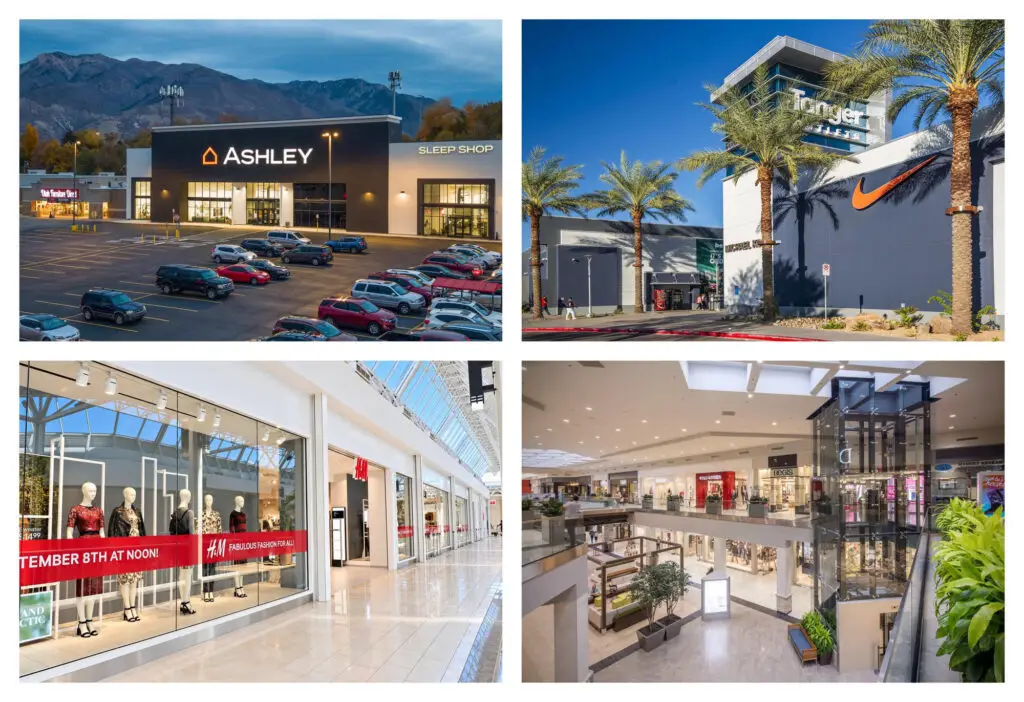
Architecture can be a very local business. Codes change from state to state. Jurisdictions develop their own priorities and interpretations. Construction practices vary. Even two cities using essentially the same building code can approach the same issue very differently.
Yet some of ADC’s longest-standing clients continue to bring us with them from one market to the next. We have completed well over 100 Ashley Furniture/HMC projects across roughly 15 states and more than 100 projects for GGP/Brookfield across approximately 35 states, along with work throughout the country for Fitness International, Tanger, Brixton Capital and others.
Those numbers are meaningful, but they are not really the story. Our clients do not take us across the country because we know every city. They take us because we know them.
The Work Followed the Relationships
Our national work was never part of a grand plan to become a national architecture firm. It happened naturally through relationships that grew over time.
Craig Chinn began working with Aaron Hodgdon, owner of HMC, in 2009. When Craig later left KTGY and started Architecture Design Collaborative, HMC became ADC’s first client. As HMC’s work with Ashley Furniture expanded, ADC went with them. GGP was one of the next clients to make that same transition. Craig had also begun working with their team in 2009, and from the beginning we were treated as an extension of their tenant coordination group rather than simply another outside architect.
The projects kept moving into new buildings, new cities and new states because the relationships kept moving with them.
That history creates a tremendous amount of knowledge that never appears in a prototype manual or drawing standard. Ashley Furniture today is not the same Ashley Furniture it was five years ago, let alone 10. Interior furniture concepts evolve. Bedding packages change. Themed walls, exterior design elements, clear heights and planning expectations continue to change. Working with the same client repeatedly does not mean repeating the last project. It means understanding how the client operates, recognizing what is changing and knowing when something needs to be questioned.
We still ask a lot of questions. In fact, the longer we work with a client, the more important those conversations become. Sometimes our response is, “Yes, we can do that.” Other times it is, “Did you think about this?” And occasionally it is, “We really don’t think you should spend money there.”
That ability to have an honest conversation is part of what the relationship becomes.
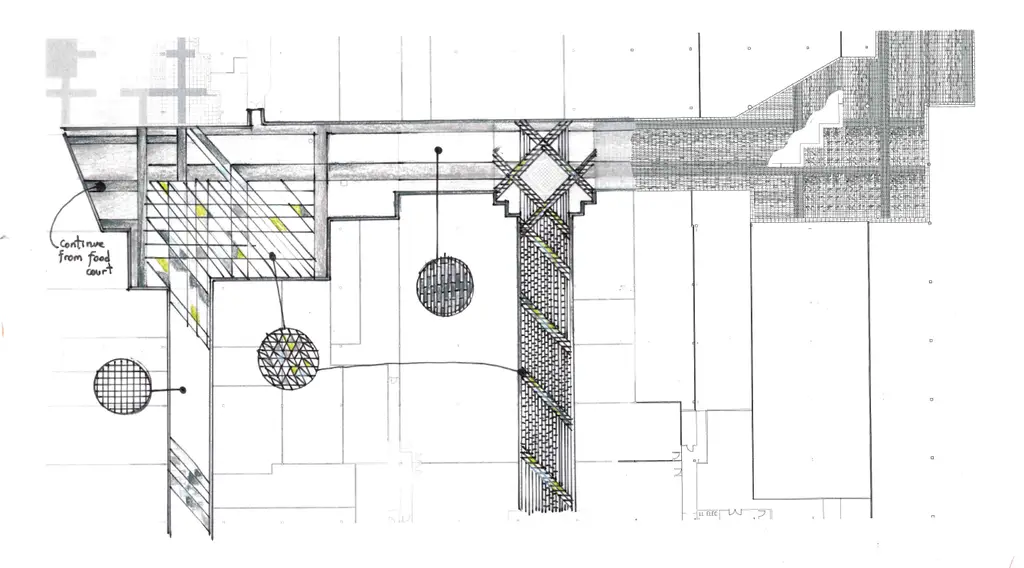
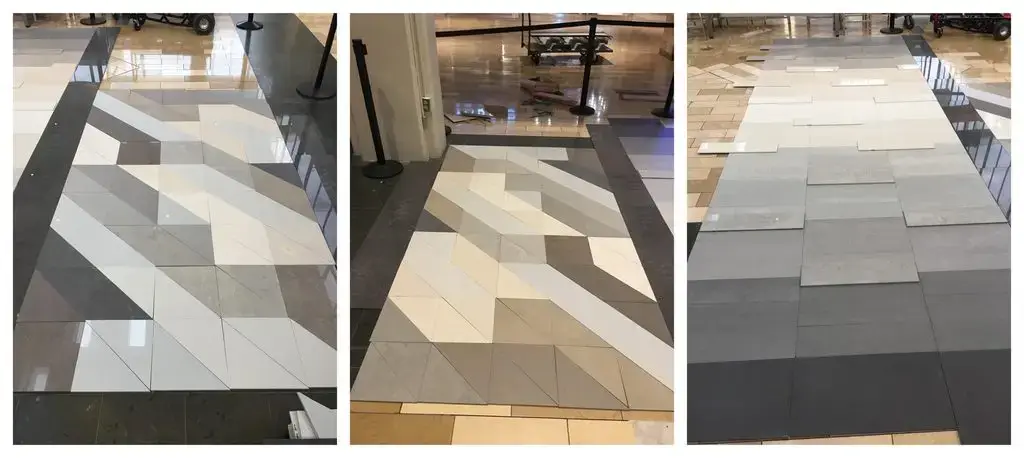
Know the Client. Learn the City.
Understanding the client is only half of working successfully across the country. The other half is understanding where the project is being built.
Every jurisdiction has priorities. One city may focus heavily on fire and life safety. Another may have particular concerns about exiting or accessibility. Somewhere else it may be an unusual local issue that has become important because of something that happened on an earlier project. Our approach is to learn those priorities early, understand how the local officials interpret the code and have the conversations that can keep potential issues from becoming problems later.
There can also be a little skepticism when the architect arriving at the meeting is from California. Craig usually breaks the ice by saying, “I’m actually from Boise. I just live in California.” It gets a laugh, but more importantly it changes the tone. From there, the goal is to talk like normal people, listen and understand what matters to the people reviewing the project.
On a complete Ashley Furniture renovation in Draper, Utah, Craig contacted the Chief Building Official before we submitted the project. He walked him through what we were proposing, explained our approach and then asked what he wanted to see addressed in the drawings. We incorporated those items into the permit set, and the project was cleared for permit after the first submittal.
That does not happen because we knew everything about Draper before we arrived. It happened because we knew enough to ask the right questions before the drawings reached the reviewer.
Listening, however, does not mean automatically agreeing. Building codes contain plenty of gray areas where interpretation matters. When we disagree with a jurisdiction, we typically start with the intent of the code rather than immediately arguing over a sentence. Why does the requirement exist? What life-safety issue is it intended to address? What problem originally caused that provision to become necessary?
Once we understand that, we can explain our interpretation and demonstrate why we believe the proposed solution still addresses the underlying life-safety concern. Knowing when to push, how hard to push and when to stop is part of the process.
Those conversations are usually better on the phone or in person. An email can make it very easy for two sides to take positions. A conversation gives everyone room to explain what they are trying to accomplish and explore another way forward.
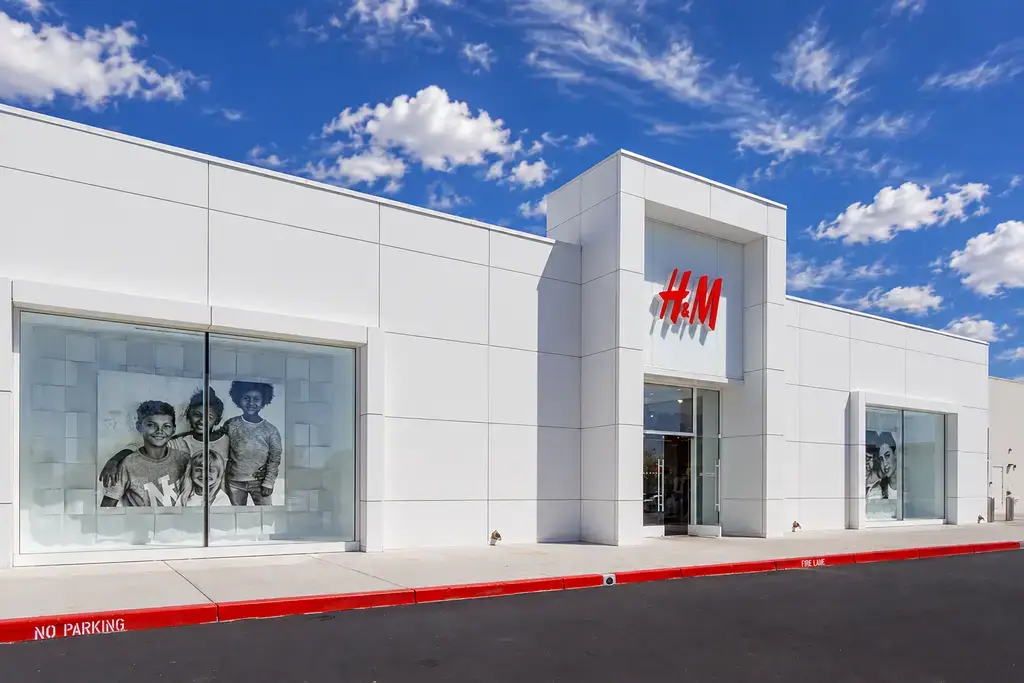
Our Coronado H&M project for GGP’s tenant coordination group is a good example. We were told the concept could not be done, and we later learned other architects had tried previously without success. Instead of treating that as the end of the discussion, Craig met with the city to understand why the previous approaches had failed, what the real concerns were and whether there was another way to solve the problem.
There was.
Don’t Make the Project Harder Than It Needs to Be
Our GGP/Brookfield work reinforced another philosophy that has become important to ADC: more drawings do not automatically make a better set of drawings.
Over more than 100 projects for GGP across roughly 35 states, we worked on approximately 15 H&M landlord projects, 10 Apple projects, numerous white-box spaces and dozens of restroom renovations. Many of the H&M projects required combining five, six or seven smaller mall spaces into one large tenant space. Existing floors might be at two or three different elevations. Utilities had to move, power requirements changed and storefronts were reconfigured. The Apple projects could be even more complicated, including column removals and increased structural loading requirements.
Those projects needed complete drawings. They did not need unnecessary drawings.
Excessive specification sheets, generic accessibility information, sections that add no value and pages of standard details that have nothing to do with the actual project can create more problems than they solve. Once information is placed in the construction documents, somebody can review it, interpret it, price it or question it.
Our goal is not to produce the fewest drawings. It is to produce the right drawings—enough information to clearly communicate and construct the project without adding noise that does not belong there.
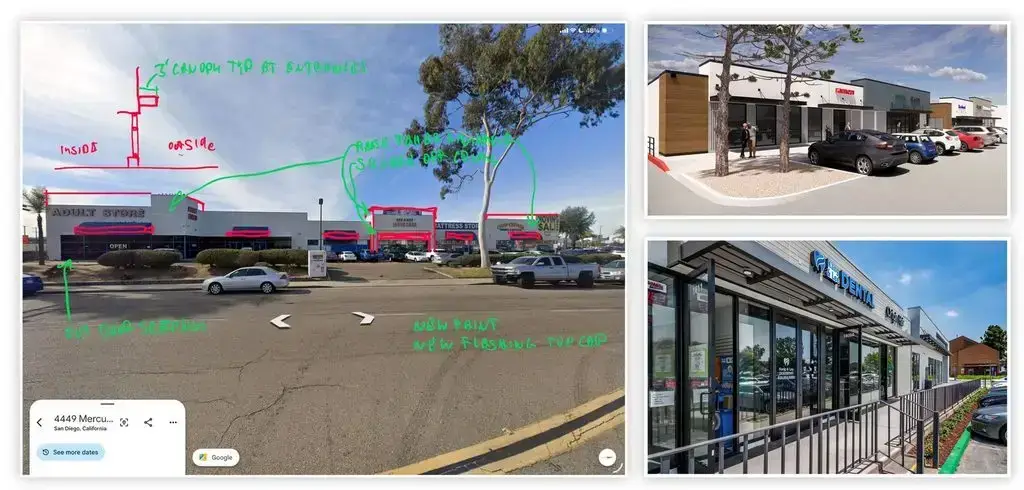
The same thinking applies to design and construction budgets. Brixton Capital once sent us a proposed shopping-center façade renovation for peer review. Craig looked at the design and had a pretty simple reaction: it was a lot of money for a relatively small impact. He sketched another approach over an image of the existing center and sent a few examples from previous projects. Brixton liked the direction and ultimately brought ADC on to complete the work.
Not every project needs to be an award winner. Sometimes a successful project is one that makes the building and its tenants look considerably better without spending money where it provides very little return.
We try to treat the client’s money as if it were our own.
“If you consistently give your clients their time back, they will keep asking you to come back. Sometimes the next project just happens to be across the country.“
Sometimes the Right Answer Is No
One of the benefits of a long-term relationship is that the client knows our first priority is not simply getting the next job.
Years ago, GGP asked ADC to complete a project in New York. Our initial reaction was that it did not make much sense for a California-based firm to take it on. GGP disagreed—they specifically wanted ADC. We became licensed in New York, completed the project successfully and have since worked there for other clients.
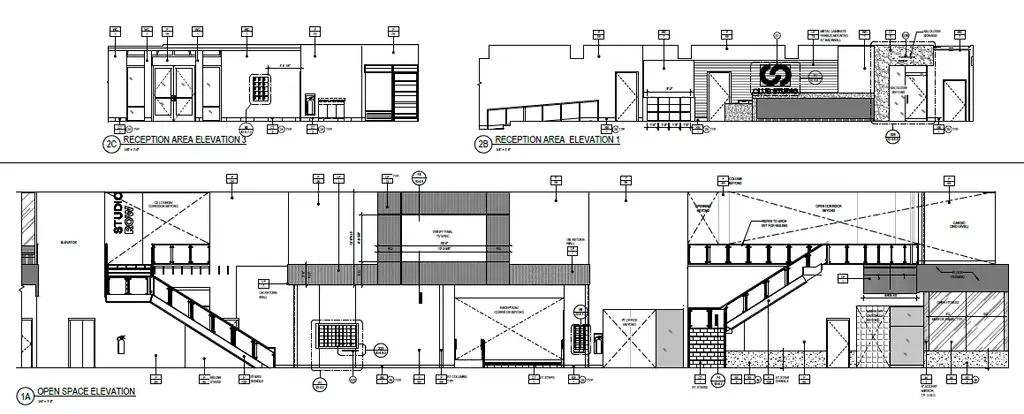
Later, Fitness International approached us about another New York project. This time we recommended something different. For that particular project’s size and scope, having a local Architect of Record available for construction-phase coordination and site visits simply made more sense. ADC remained involved as the interior designer, allowing us to continue supporting the project in the role where we could provide the most value.
Same state. Different project. Different answer.
Our first response when a repeat client asks us to work somewhere new is usually, “Yes, we can figure it out.” Then we slow down and decide whether it actually makes sense. Smaller, straightforward projects can often be completed efficiently without significant travel. Large projects usually have the budget and complexity to justify additional coordination. The projects in the middle can sometimes be the hardest because repeated travel begins to work against the economics of the job.
Our clients appreciate that honesty. Sometimes serving them well means taking the project. Sometimes it means explaining why someone else should.
Give Them Their Time Back
Ultimately, there is an even simpler reason our clients continue to work with ADC.
They like working with us.
We listen, ask questions and bring up potential problems before they become bigger ones. We keep projects organized and help our clients stay organized. We push back when something creates unnecessary cost or delay, and we tell them when we believe something simply is not worth doing.
All of those things lead back to something we think about constantly: giving our clients their time back.
It may mean keeping a meeting to 30 minutes instead of an hour. It may mean getting a permit one review cycle sooner, avoiding an unnecessary construction issue, making a decision quickly or helping a client recognize that an improvement is not worth pursuing in the first place.
Clients already have more competing for their attention than they have time to manage. If we can remove a few of those things from their plate, we have created real value.